

Published on: 01/04/2026
This news was posted by Apex Wealth Advisors


Description

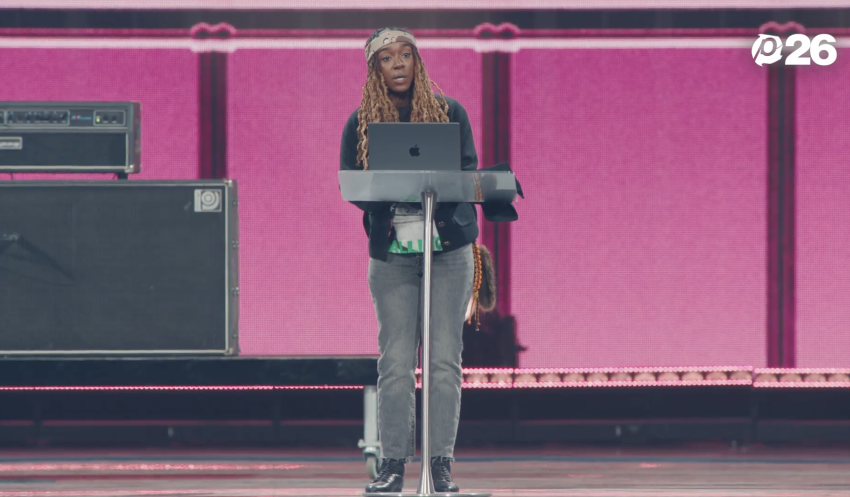
Standing before tens of thousands of college students and young adults at Passion 2026, Jackie Hill Perry delivered a message centered on the paradox of the Christian faith: that salvation comes not through self-preservation and human heroism, but through surrender and the death of Jesus Christ.
Perry, an author, Bible teacher and poet, opened her message delivered before thousands gathered at Globe Life Field in Arlington, Texas, with an illustration drawn from the 1997 film “Titanic.” Recounting the now-famous scene in which Jack Dawson sacrifices his life so Rose DeWitt Bukater can survive, Perry highlighted the longstanding debate over whether the floating door could have saved them both.
“People love saviors,” the 36-year-old Upon Waking author said. “We love heroes. We love those who will sacrifice themselves for the greater good. What we don’t like are those who save themselves.”
The scene, Perry contended, resonates so deeply because it exposes something fundamental about human nature. People want to see themselves as the heroic figure who gives their life for others. But in reality, she said, humanity more closely resembles Rose, the one who must be saved.
“That’s why that scene sticks with us,” Perry said. “We all want to be like Jack. But we are actually like Rose.”
Reading from Luke 23:32-43, Perry focused on the moment Jesus is crucified between two criminals, mocked by religious leaders, soldiers and even one of the thieves beside Him.
Again and again, the crowd around the cross issued the same challenge: “Save yourself.”
Perry noted that the demand echoes throughout the Gospel narrative, from Satan’s temptation of Jesus in the wilderness to Peter’s insistence that the Messiah should not suffer. Each time, the temptation is the same: use divine power to preserve life and escape suffering.
“But they didn’t know what they were asking for,” Perry said. “They hadn’t read the script.”
Quoting filmmaker James Cameron’s explanation for Jack’s death in “Titanic” — “It says on page 147 of the script that Jack dies” — Perry said the same logic applies to the cross. Jesus’ death was the point.
“The man in the middle cross isn’t the one who needs to be saved from death,” she said. “It is always us.”
Perry traced the story of Jesus’ crucifixion backward through the Gospel of Luke, from His condemnation by religious leaders to His betrayal by Judas, His anguished prayer in Gethsemane, the Last Supper and the prophetic declarations surrounding His birth and identity. Each moment, she stressed, reinforced the same truth: Jesus’ death was always part of God’s redemptive plan.
She also pointed to Luke’s genealogy, which traces Jesus’ lineage back to Adam, “the son of God,” emphasizing that Christ stands both within human history and above it, uniquely qualified to deal with humanity’s deepest problem: sin.
“Here is the Son of God,” Perry said, “being put to death like a sinner.”
To the left and right, she noted, were men who truly were guilty, criminals who had broken both Roman law and God’s law. Jesus, by contrast, had committed no sin, yet bore the punishment of the guilty.
To explain why, Perry turned to Genesis 3 and the fall of humanity. When Adam sinned, she said, death entered the human condition, not just physical death, but spiritual separation from God. Because Adam is the father of humanity, all people inherit his sin and its consequences.
“The wages of sin is death,” she said. “Every single person who has ever been born is born deserving death.”
Yet even in Genesis, Perry said, God announced a plan of rescue: a coming offspring who would be wounded by Satan but ultimately crush him. That promise, she said, finds its fulfillment in Jesus, born of a virgin, sinless and able to defeat sin and death.
“Jesus was not on the cross because He was a criminal,” Perry said. “He was on the cross because we are.”
Perry returned repeatedly to the mocking refrain hurled at Jesus: “Save yourself,” a demand she said revealed more about humanity than about Christ.
“We use our gifts to save us from certain insecurities. We use our friends to save us from what our parents are lacking in. We use drugs and intoxicants to save us from anxiety and boredom. We even use legalism, dressed up as faith, to save us from having to repent for real. We are all always trying to save ourselves from something, and it is because we don't believe that what Christ accomplished on the cross is able to save to the uttermost,” she emphasized.
In contrast, the cross exposes the limits of self-salvation. To the “natural mind,” she said, a bleeding, crucified Savior looks foolish, incapable of addressing guilt, shame or sin. Yet Scripture insists that it is precisely through Christ’s weakness that salvation is accomplished.
“Kings don’t hang on crosses,” Perry said. “Unless the King is Yahweh.”
One of the sermon’s most emotionally charged moments came as Perry examined the transformation of one of the criminals crucified alongside Jesus. According to the Gospel accounts, both thieves initially mocked Christ. Yet at some point, one undergoes a radical change of heart, rebuking the other and acknowledging his own guilt.
“What happened?” Perry asked.
Though Scripture does not describe the moment in detail, Perry suggested the turning point may have come when Jesus prayed, “Father, forgive them, for they know not what they do.”
“Jesus has been unjustly condemned. Jesus has been beat up. He has a crown of thorns on His head. Both of His hands and His feet have been pierced to the wood, and there between the two criminals, He hangs naked while everybody beneath Him is throwing insults. That's a lot of personal injury for any human being to take, let alone one who claims to be the Son of God.”
That display of forgiveness amid humiliation, she explained, likely awakened the thief to his own sinfulness and Jesus’ innocence. If God could forgive those crucifying His Son, perhaps there was hope even for a criminal.
Perry emphasized that salvation is not merely about being spared suffering or earthly consequences. One thief wanted Jesus to save him from the cross; the other recognized that he needed saving from God’s judgment and reconciliation to God Himself.
“To be saved by God is to be saved from God for God,” she said.
Drawing from Romans 3, Perry explained the doctrine of substitutionary atonement: that Jesus’ death satisfies God’s justice while extending mercy to sinners. Through Christ’s sacrifice, God remains both “just and the justifier” of those who have faith.
The thief’s final request — “Jesus, remember me when you come into your Kingdom” — demonstrated extraordinary faith, Perry said. Despite Christ’s apparent weakness, the man recognized Him as a king with authority beyond death. Salvation, she emphasized, is achieved solely by trusting the “man on the middle cross.”
To illustrate the point, Perry recounted a story often told by preacher Alistair Begg: imagining the thief arriving in Heaven with no résumé of religious accomplishments, able to offer only one explanation for his presence.
“The man on the middle cross said I could come,” Perry concluded her message, followed by a time of worship led by artist Brooke Ligertwood.
The Passion movement was founded in 1995 by Louie Giglio and Shelley Giglio to call college-aged young adults to live for what the organization describes as “the name and renown of Jesus.” Other speakers at this year’s conference include Earl McClellan, Jonathan Pokluda and Sadie Robertson Huff.
News Source : https://www.christianpost.com/news/jackie-hill-perry-talks-man-on-the-middle-cross-at-passion-2026.html
Other Related News

01/05/2026
One of my favorite hobbies in the world is making bread The process is so satisfying s...

01/04/2026
By Chris Carpenter Contributor Sunday January 04 2026Author Brent Rittersdorf has releas...
01/04/2026
By Michael Gryboski Editor Sunday January 04 2026A 14th century depiction of Pope Innoce...

01/04/2026
I stood on the still-damp grass scanning across the long field The surrounding trees obscu...

01/03/2026
By Anugrah Kumar Christian Post Contributor Saturday January 03 2026The moment Joe Junio...

Follow


Download Our App


Copyright 2022 © Pro Preview. All Rights Reserved