

Published on: 04/28/2026
This news was posted by Apex Wealth Advisors


Description

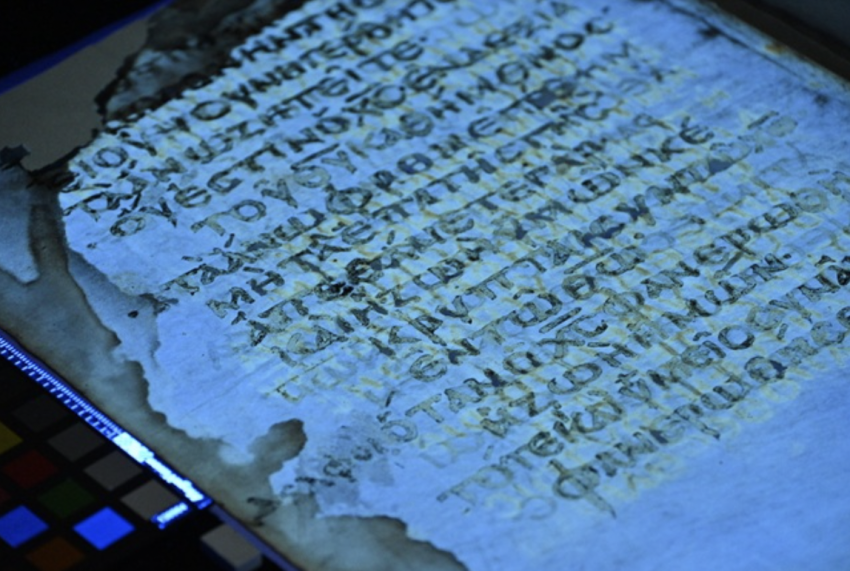
An international team of researchers has recovered dozens of long-lost pages from one of Christianity’s earliest New Testament manuscripts, including the letters of Apostle Paul, shedding new light on how early believers read and studied Scripture.
Led by the University of Glasgow, the team used advanced imaging technology to recover 42 missing pages from Codex H, a sixth-century Greek manuscript containing the letters of Apostle Paul, according to an announcement from the university.
The manuscript, also known as GA 015, had been dismantled in the 13th century at a monastery on Mount Athos, where its parchment pages were repurposed as binding material for other books. Over centuries, its surviving fragments were scattered across libraries throughout Europe, with many pages believed to be permanently lost.
Researchers say the breakthrough came through the use of multispectral imaging, a technique that captures images under different wavelengths of light, from ultraviolet to infrared. The method revealed faint “ghost” traces of ink that had transferred between pages when the manuscript was reused, allowing scholars to reconstruct text that had been invisible for centuries.
“We knew that at one point, the manuscript was re-inked,” said Professor Garrick Allen of the University of Glasgow. “The chemicals in the new ink caused ‘offset’ damage to facing pages, essentially creating a mirror image of the text … [it is] very clear with latest imaging techniques.”
Among the key findings are some of the earliest known chapter lists for Paul’s writings, which differ significantly from modern Bible divisions. Researchers also found evidence of how scribes corrected and annotated texts, shedding light on the intellectual and devotional practices of early Christian communities.
The manuscript’s condition further reveals how damaged or aging texts were repurposed in the medieval period, offering insight into the historical lifecycle of sacred writings.
“Given that Codex H is such an important witness to our understanding of Christian Scripture, to have discovered any new evidence — let alone this quantity — of what it originally looked like is nothing short of monumental,” Allen said.
To verify the manuscript’s origins, researchers collaborated with experts in Paris to conduct radiocarbon dating, confirming the parchment dates back to the 6th century.
The project, conducted in partnership with the Early Manuscripts Electronic Library and supported by multiple research foundations, also involved cooperation from the monastery that still holds portions of the manuscript.
The findings come on the heels of another significant biblical-era discovery in Jerusalem, where archaeologists recently uncovered a rare 2,700-year-old clay fragment bearing an Assyrian inscription near the Temple Mount.
The one-inch artifact, found last year and believed to be part of a seal used to authenticate official documents, was discovered during an excavation of a drainage canal led by the Israel Antiquities Authority in collaboration with the City of David Foundation.
Researchers said the composition of the clay suggests it originated from the Tigris basin, indicating it likely arrived in Jerusalem as part of official Assyrian correspondence.
Israeli tour guide Yoav Rotem said the artifact appears to date to the time of King Hezekiah and may relate to the events described in 2 Kings 18, when the Assyrian empire pressured Judah for tribute.
“If you remember, King Hezekiah is facing a military campaign coming from Assyria,” Rotem said, noting the biblical account of mounting tension between Judah and the Assyrian empire.
News Source : https://www.christianpost.com/news/long-lost-pages-of-pauls-letters-recovered.html
Other Related News
04/28/2026
By Christian Daily InternationalTuesday April 28 2026A mosaic seen on the gate of St Ant...

04/28/2026
By Ryan Foley Christian Post Reporter Tuesday April 28 2026Rose Docherty ADF Internatio...

04/28/2026
By Michael Gryboski Editor Tuesday April 28 2026Volunteers with University United Method...

04/28/2026
By Anugrah Kumar Christian Post Contributor Tuesday April 28 2026Unsplashludovico di gio...

04/28/2026
JERUSALEM Israel This past week in Jerusalem a ceremony to remember Israels fallen soldie...

Follow


Download Our App


Copyright 2022 © Pro Preview. All Rights Reserved