

Published on: 05/11/2026
This news was posted by Apex Wealth Advisors


Description
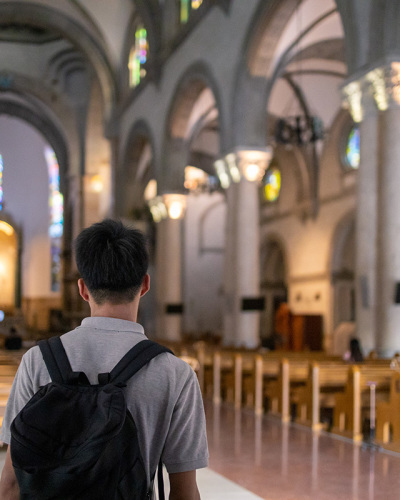
The Wall Street Journal recently reported that young New Yorkers have a new hot spot: Sunday Mass.
At St. Joseph’s Church in Greenwich Village, “A recent 6 p.m. Sunday Mass felt like a sold-out event. Every inch of pew space was filled, mostly with young adults. Latecomers squeezed into makeshift rows of plastic folding chairs or stood shoulder-to-shoulder in the foyer, peering through glass doors. Others squatted on balcony steps or leaned against walls for the roughly 90-minute service.”
What’s behind the surge in interest?
The article gives several reasons, including the search for community after the pandemic and the killing of conservative activist Charlie Kirk, part of a wave of high-profile incidents of political violence nationwide that has turned hearts in a different direction. But another cause has been the realized emptiness of being “spiritual but not religious”.
Although there are reports of more spirituality than ever with greater access to spiritual teachings and experiences, it’s been accompanied by less commitment and clarity. The result has been a faith that is deeply personal, but superficial; a spirituality that seems empowering, but doesn’t transform; a search that is always moving, but never resolving.
Why?
Well, there is that itsy-bitsy issue of it not being a true faith. And what else do you expect but a face plant from something false?
The disaster of doing what’s right in our own eyes
We’ve seen a few shots over the bow warning about this. A major review in Current Opinion in Psychology found that those spiritual but not religious (SBNR) “tend to be higher on neuroticism”, which is a personality trait associated with anxiety, emotional instability, and stress reactivity.
A study published in the journal Religions found that SBNR individuals often report: “struggles…with existential issues” that include unresolved questions about meaning, tension around belief, and lack of clarity about identity and purpose. There’s also a 2026 study in Scientific Reports that examined non-religious spiritual practices closely aligned with SBNR identity and found associations with anxiety and depressive symptoms.
Getting theological for just a minute, it looks like some people find out the hard way that breaking the first commandment comes with very real and personal consequences.
The individualized, anti-institutional, slippery, and self-directed spirituality is really just a reenactment of Judges 21:25: “Everyone did what was right in his own eyes.” And look at how well that worked out for Israel.
An ugly aspect of the SBNR route is that it’s often heavily shaped by social media platforms like TikTok and Instagram, which optimize for one thing and only one thing – engagement. You won’t find the testing of truth claims there; it’s where truth isn’t received, but constructed.
Look long enough on those platforms, and you’ll find someone telling you what you want to hear, just like Paul warned: “They will accumulate for themselves teachers to suit their own passions” (2 Tim. 4:3). The conversations on those platforms show that Paul’s words aren’t ancient history; they reflect modern spirituality with better technology.
Although discussions occur in those spaces, they only resonate emotionally, reinforce existing views, and avoid friction or challenge at all costs. The result is an echo chamber that is superficially meaningful for the moment but never examined, and thus never lasting.
That’s what serving a false god will get you. Remember the adage that idols can be both metal and mental?
I don’t think there’s a better illustration of what’s happening today with the SBNR crowd than the picture Isaiah paints where he portrays a man who takes wood, “Then it becomes something for a man to burn, so he takes one of them and warms himself; he also makes a fire to bake bread. He also makes a god and worships it; he makes it a graven image and falls down before it. Half of it he burns in the fire; over this half he eats meat as he roasts a roast and is satisfied. He also warms himself and says, “Aha! I am warm, I have seen the fire.” But the rest of it he makes into a god, his graven image. He falls down before it and worships; he also prays to it and says, “Deliver me, for you are my god.” They do not know, nor do they understand, for He has smeared over their eyes so that they cannot see and their hearts so that they cannot comprehend. No one recalls, nor is there knowledge or understanding to say, “I have burned half of it in the fire and also have baked bread over its coals. I roast meat and eat it. Then I make the rest of it into an abomination, I fall down before a block of wood!” (Is. 44:15-19).
And what’s the result? “A deceived heart has turned him aside. And he cannot deliver himself” (Is. 44:20). Just like the SBNR crowd today, who find their made-up spirituality has no real power either, which leaves them empty.
There’s room for hope, though, if what’s happening at St. Joseph’s and other churches is indicative of SBNR folks and others finding the real God and a saving relationship with Christ. Because in the end, the hunger driving all of this isn’t just for experience, but for something solid, true, and outside of us.
And according to Scripture, that something isn’t found by curating your own path. Rather, it’s found by surrendering to the one that God has already given.
Robin Schumacher is an accomplished software executive and Christian apologist who has written many articles, authored and contributed to several Christian books, appeared on nationally syndicated radio programs, and presented at apologetic events. He holds a BS in Business, Master's in Christian apologetics and a Ph.D. in New Testament. His latest book is, A Confident Faith: Winning people to Christ with the apologetics of the Apostle Paul.
News Source : https://www.christianpost.com/news/why-being-spiritual-but-not-religious-eventually-face-plants.html
Other Related News


05/11/2026
The Passover celebration is a reminder of the time God liberated His people from slavery w...

05/10/2026
COMMENTARY When my daughter Kenzi was born I thought I had already crossed my desert And ...

05/10/2026
By Leah MarieAnn Klett Assistant Editor Sunday May 10 2026Jennie Lusko leads Fresh Life ...
05/10/2026
By Michael Gryboski Editor Sunday May 10 2026The former Andrews Methodist Church is the ...

Follow


Download Our App


Copyright 2022 © Pro Preview. All Rights Reserved